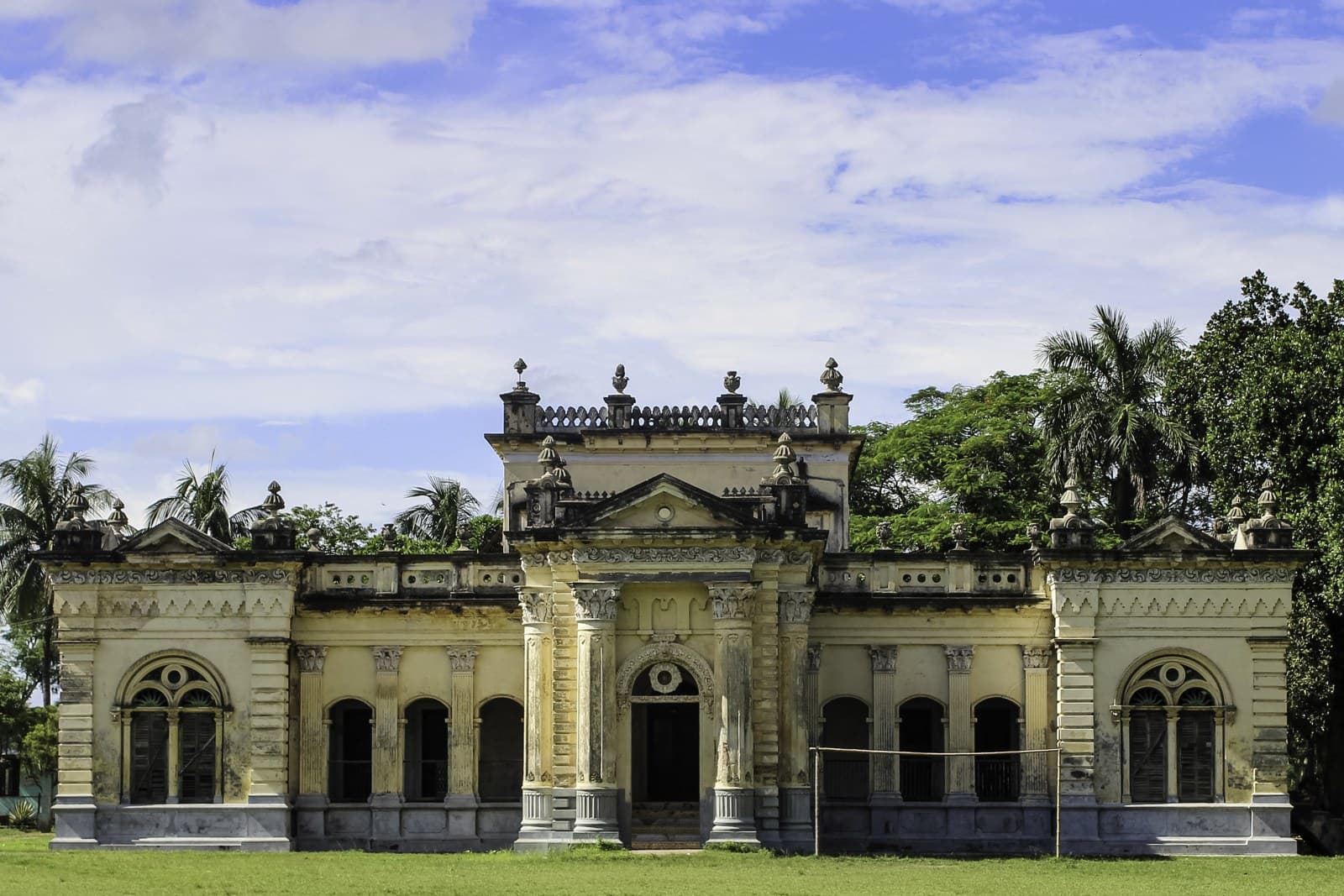
The district of Jibanananda's 'Banalata Sen of Natore', Natore is known for its palaces, wetlands and kachagolla. Right in town lies the roughly 50-acre Natore Rajbari, with a double moat, the Boro Torof and Chhoto Torof palaces, memories of Rani Bhabani and the Tarakeshwar Shiva temple. About 3 km away at Dighapatia is Uttara Ganabhaban, with its Italian clock gate, a garden of marble statues and a museum of royal belongings.
The monsoon shows another face: Halti Beel in Naldanga and, via Singra, Chalan Beel — the country's largest beel — where boat trips peak in Asharh–Shrabon. Bonpara market, held twice a week, is worth a look, and Rajshahi's Puthia Rajbari is close by. For history lovers, families and monsoon wetland seekers, Natore is easy to reach by train: the palaces in one day, two days with the beels.
1) By train: from Kamalapur the Ekota (10:10), Rangpur Express (9:10), Nilsagar (6:40), Drutojan (8 pm) and Lalmoni Express (9:45 pm) stop at Natore, taking 4.5–5 hours. Some trains have a weekly off day, so check the e-ticket site.
2) By bus: Rajshahi-bound coaches of Hanif, Desh Travels, Shyamoli, National and Green Line from Gabtoli and Kallyanpur pass through Natore in about 4–5 hours; tell the supervisor you are getting off at Natore.
3) In town: rickshaw/auto from the station or bus stand reaches the Rajbari in minutes; inside, you can bargain for a horse-carriage round. Uttara Ganabhaban is about 15 minutes by CNG/auto.
4) The beels: Halti Beel is in Naldanga upazila, reachable by CNG/auto from town. For Chalan Beel take a bus to Singra and hire a boat there; whole boats are hired by the hour. After a fatal boat accident in October 2023 the administration suspended tourist boats on Halti Beel — check locally before you go.
History & identity
Natore was part of ancient Pundravardhana, then under Pala and Sena rule. In the Mughal period Murshid Quli Khan granted the Natore Raj family a vast estate; Raja Ramjivan built the first palace between 1706 and 1710. After his adopted son Ramkanta died, Rani Bhabani (1715–1802) ran the estate from 1748 and became famous for building roads, tanks, temples and schools. In 1734 Dayaram Roy, dewan of the Natore Raj, began the Dighapatia palace. Natore was the headquarters of Rajshahi district from 1769 to 1825, and its municipality dates from 1869. The 1897 earthquake badly damaged both palaces. The Dighapatia palace became the Governor House in 1967 and Uttara Ganabhaban on 9 February 1972. In 1971 there was a battle at Lalpur on 29 March, and on 5 May employees of the North Bengal Sugar Mills were massacred at Gopalpur. Historian Jadunath Sarkar and folk singer Farida Parveen came from here. Natore became a district in 1984.
Local food & products
Natore means kachagolla — Dwarik Bhandar in the old Joykali Bari area is described as its original shop. For lunch, town restaurants serve plain Bengali meals of rice, fish, dal and bhorta; freshwater fish from the Chalan Beel area is the local strength. There is no food inside Uttara Ganabhaban, so eat in town.
Where to stay
Many visitors do Natore as a day trip from Rajshahi or Dhaka. If you stay, the town has basic residential hotels such as Hotel VIP and Hotel Rukhsana. For better hotels, stay in Rajshahi city, about 50 km away via Puthia; it also has a Parjatan Motel.